| Age group | With primary malformation (n=22) | With secondary malformation (n= 14) | P | |
| ≤ 1 year | 0.332 | |||
| Normal | 0 | 1 | ||
| Death | 3 | 5 | ||
| Neurological sequelae | 1 | 3 | ||
| Loss | 3 | 3 | ||
| 1-3 years | - | |||
| Normal | 0 | 0 | ||
| Death | 0 | 0 | ||
| Neurological sequelae | 4 | 0 | ||
| Loss | 3 | 0 | ||
| >3 years | 0.759 | |||
| Normal | 0 | 0 | ||
| Death | 0 | 0 | ||
| Neurological sequelae | 3 | 1 | ||
| Loss | 5 | 1 |

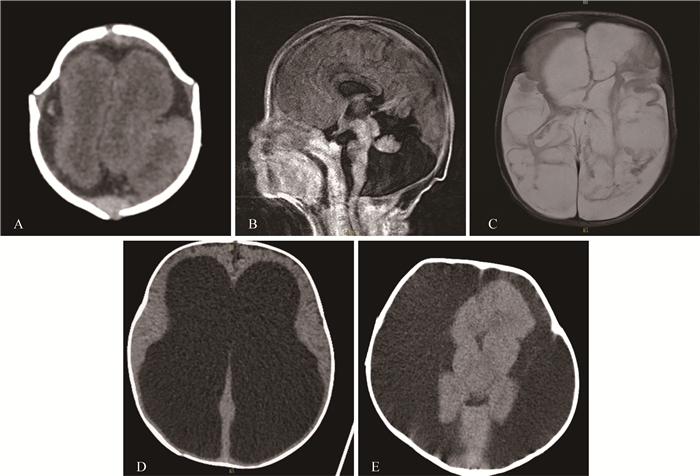
Fig 1 Imaging demonstrations of CNS malformations in the ≤ 1-year-old group A: CT revealed lissencephaly in a one-month-old infant; B: Dandy-walker malformation was found on sagittal MRI in a 1-month-old infant who died 3 months after birth; C: The cystic changes in bilateral cerebral parenchyma was found on MRI in a 2-month-old infant; D: The heavy hydrocephalus was found on CT in a 2-month-old infant who died after one-month treatment; E: The extent subdural effusion was found on CT for a 10-month-old infant who died one year after birth.
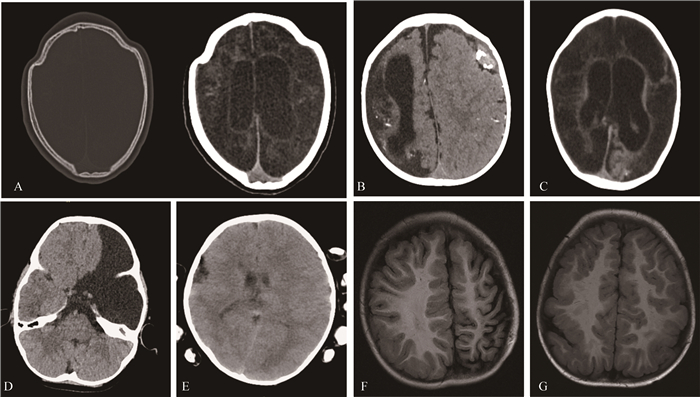
Fig 2 Imaging demonstrations of CNS malformations in the 1- to 3-year-old group and>3-year-old group A: The irregular contour of the cranium suggests craniosynostosis in a 24-month-old infant (left) and the relatively low density in both cerebral parenchyma was found(right); B: The dysplasia of gyrus in the right hemisphere and the corresponding porencephaly was found on CT image in a 24-month-old infant. The high-density hematoma was also found in the contralateral subdural space; C: The CT indicated the extent low density of both cerebral parenchyma in a 36-month-old infant. D: The absence of left frontal lobe in axial CT was found in a 48-month-old child. The subsequent follow-up demonstrated the barylalia with normal movement function; E: The giant gyrus in the right and the polygyria in left hemisphere on CT was found in a 60-month-old child. F: The dysplasia of left both frontal and parietal lobe was found on MRI in a 48-month-old infant. G: The polygyria was found in both the bilateral frontal and parietal lobe on axial MRI in a 48-month-old infant.